

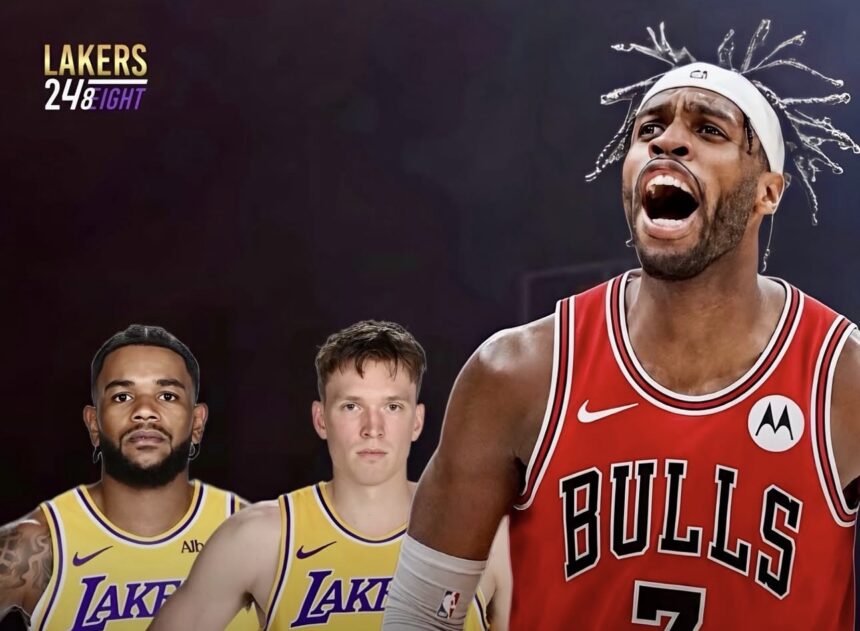
The Lakers have been linked to Buddy Hield multiple times in the past. Now it seems they finally got their chance at getting the sharpshooter, but declined the offer.
According to Brett Siegel of ClutchPoints, Los Angeles explored that possibility throughout the offseason and even had an opportunity to acquire Buddy Hield in a two-for-one deal.
The Los Angeles Lakers have a roster decision to make before the regular season begins. A trade may provide the cleanest solution. Los Angeles currently has 16 players on guaranteed contracts, one more than the regular-season maximum of 15. This of course means someone will eventually have to go.
Two-For-One Trade For Buddy Hield
Siegel reported that the Lakers could have acquired Hield by sending out two players, but the organization ultimately decided against completing the trade.
“Sources say the Lakers could’ve made a ‘2-for-1 move’ to trade for Hield, but the organization ultimately elected against doing so. Although the exact reasoning for this was not provided, one can assume the main reason for this is due to Los Angeles likely needing to include a second-round pick to move two contracts.”
Hield would have provided additional shooting while simultaneously solving the Lakers’ roster crunch. However, if Los Angeles needed to sacrifice draft capital to consolidate two contracts, passing on the opportunity is understandable.
The Lakers have already changed a lot of their supporting cast this offseason. So adding another guard might not have been their top priority. Still, since they have one extra player, it makes sense to consider a two-for-one trade.
Don’t Waste Draft Capital
A consolidation trade makes plenty of sense if the Lakers can turn two players on the back end of their roster into someone who better addresses a need. It would solve the numbers problem while potentially strengthening a rotation built around Luka Doncic and Austin Reaves.
What makes less sense is attaching draft capital to get down to 15 guaranteed contracts. If the Lakers are going to sacrifice a second-round pick or another asset, they should be getting back a player they believe can meaningfully improve the roster.
A backup big or starting-caliber wing would make considerably more sense because either addition could fill a legitimate need while simultaneously opening a roster spot. Those are areas where another dependable rotation player could give the Lakers additional lineup flexibility as they finalize the group around their stars.
Otherwise, Los Angeles may be better off simply waiving a player and carrying the resulting dead money on its books. Losing a player without receiving anything in return isn’t ideal, but using draft capital solely to avoid making that decision could prove even more costly in the long run.
Financial Incentive
The Lakers also have a financial component worth monitoring as they evaluate their options. Los Angeles currently sits about $470,000 above the luxury-tax line. Yet another reason to explore a move that eventually reduces salary.
That is relatively small compared to an NBA payroll. This should give the Lakers several avenues to get below the line. It also means Los Angeles doesn’t necessarily need to force a financially motivated transaction before deciding its best basketball move.
The ideal scenario would accomplish multiple objectives at once. If the Lakers can consolidate two contracts into one useful rotation player while shedding enough salary to get below the tax, the front office could solve its roster and financial situation with a single transaction.
Training Camp Battle
Training camp allows the Lakers to evaluate the players competing at the back of the roster before making a final decision. Rather than rushing into a trade because they currently have 16 guaranteed contracts, Los Angeles can use the preseason to determine which players deserve to remain on the roster.
If the right trade doesn’t materialize, waiving a player remains the simplest way to get from 16 guaranteed contracts to 15. The Lakers would have to carry the dead money, but that may still be preferable to attaching an asset to a trade that doesn’t meaningfully improve the team.
Siegel’s reporting indicates the Lakers have already explored consolidation opportunities, and their current roster construction gives them reason to keep those conversations going. Los Angeles doesn’t need to make a trade just for the sake of making one. But if the roster crunch can be turned into one final upgrade while also helping the team’s tax situation, it’s an opportunity worth exploring.