


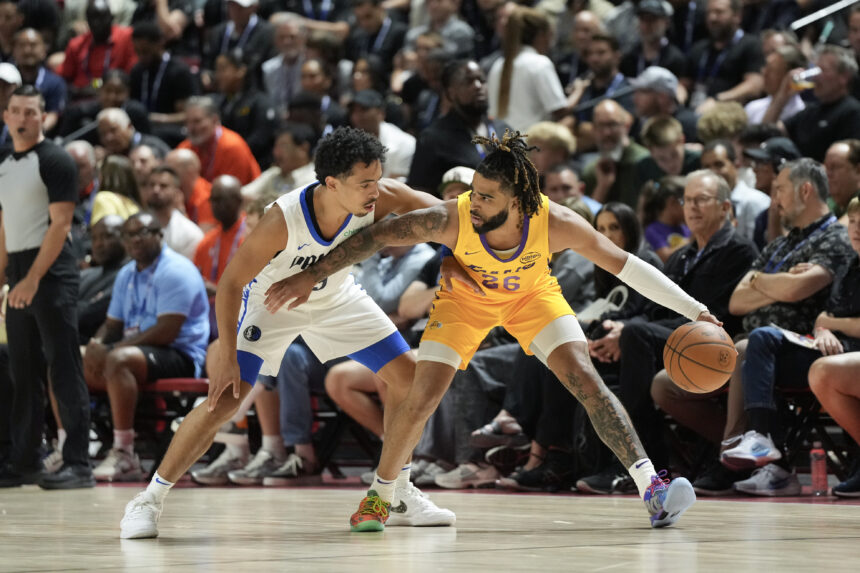
When the Lakers tipped off their preseason, R.J. Davis—a former UNC standout who signed an Exhibit 10 deal with L.A. after going undrafted—came into the spotlight. Davis hasn’t just clocked garbage minutes. He’s been one of the more active guards, taking full advantage of his time on the court, and edging ahead of other two-way hopefuls in the rotation.
Game 1 (vs. Phoenix Suns)
In his debut, Davis scored 14 points in 18 minutes (5-of-8 FG, 1-of-2 3PT, 3-of-3 FT), plus a steal. Among Lakers scorers, he was second only to Austin Reaves. Lakers coach JJ Redick even gave him a shoutout in his postgame interview, acknowledging him as one of the players who made a positive impact. For a rookie in limited minutes, that kind of public nod is meaningful.
Game 2 (vs. Golden State Warriors)
With many regulars out, Davis saw an extended opportunity. He contributed 11 points off the bench and was one of the first guards subbed in. That shows trust from the coaching staff in his ability to carry some load in the second units.
One recurring theme: in both games, Davis is seeing the floor ahead of the current two-way players. One such two-way prospect, Chris Mannon, has yet to log any minutes. This disparity in usage is a strong signal—Davis is being tested, given an opportunity to show he belongs.
Fighting for a Two-Way Roster Spot
The Lakers’ management structured Davis’ deal to allow room for evaluation. His Exhibit 10 contract means the organization can convert him into a two-way deal if he proves worthy, or send him to their G League affiliate with a bonus.
His early play offers several arguments in his favor:
- Efficiency in Limited Minutes
Young players, especially guards, often struggle with consistency in the early stages. But Davis has been sharp. His shooting splits in Game 1 (62.5% FG, perfect FT) and decent usage in Game 2 suggest he can be a high-effort, productive spark. - Coach Endorsement & Spotlight
Redick’s praise is not something to take lightly. Naming him a “bright spot” and “positive stand-out” elevates Davis in the internal hierarchy. Players must justify court time; Davis is turning his into better chances. - Outpacing Peers
Earning the coach’s trust means Davis has been more reliable than the two-way candidates or fellow unsigned prospects. If he continues to take advantage of his time on the floor, he can see his minutes increase and further move ahead of his training camp competitors.
Hurdles He Must Clear
Of course, Davis still has obstacles to clear:
- Defensive consistency: At 6’0″, he’ll need to prove he can hold up on-ball and in team schemes.
- Playmaking & creation under pressure: Opponents will test him in pick-and-roll or against length.
- Sustained performance: A game or two is one thing; stringing together steady, impactful stretches will separate him from fringe status.
What to Watch Next
- Will Redick continue inserting Davis early in the second and fourth quarters? Consistency in rotation is a strong vote of confidence.
- Does Davis begin to overtake—or at least compete closely with—the two-way players in minutes and influence?
- How do his numbers scale when regulars return and spacing/lineups change?
If Davis can maintain production, stay engaged on defense, and absorb tougher assignments, the Lakers might find they have a two-way bargain who can contribute beyond expectations.